
Why leaks cost more than the noise suggests
Compressed air is expensive to make before it ever reaches a tool. A compressor spends electricity compressing air to working pressure, and every bit of that air that escapes through a fitting or a worn hose has already cost the full price of compression, whether it does any work or not. That is the part that surprises people: a leak is not free air, it is paid-for air going nowhere.
Pressure makes this worse than it first looks. Atlas Copco states that each extra bar of pressure takes about 7% more power to produce, so a system run harder than it needs to be is paying more for every litre of air it loses. A workshop running at a higher pressure than its tools actually require is compounding the cost of every leak already on the system, before a single new one appears.
Working out what a leak is actually costing
The figures needed are the ones already on the compressor's data plate and in the electricity bill: the free air delivery in litres per minute, the electrical input in kilowatts at full load, the hours a year the system runs under pressure, and the price paid per kilowatt hour. Once the leak itself is measured, or estimated as a share of the compressor's running time from a no-demand test, those numbers turn into a share of the compressor's output, a power draw, an energy cost a year and a figure in pounds. The Leak Cost Calculator runs that arithmetic from whatever figures are entered, and it can only be as right as the numbers going in, so a rough estimate of leak size gives a rough estimate of cost.
Put the running hours and the electricity price into that same arithmetic and the annual figure usually lands somewhere a workshop owner did not expect, because a leak that sounds trivial when heard is still running for every hour the compressor is pressurised.
The four numbers behind the figure
Four things set what a leak actually costs you, and each one changes the total independently of the others.
| Factor | What it changes | What to check |
|---|---|---|
| Hole sizeOften the cheapest one to fix once found | Sets how much air escapes each minute; a wider gap or split loses air faster than a pinhole | Where the leak actually is |
| System pressureRunning at the lowest pressure the tools need cuts this cost without touching the leak itself | Pushes more air through the same hole the higher it runs | The pressure your compressor is set to cut in and out at |
| Running hoursIsolating a section when it's not needed removes this cost for that section | A leak only costs money while the system is pressurised, whether the compressor is running or the receiver is just holding pressure | Whether the line stays pressurised overnight, at weekends or between shifts |
| Electricity priceOutside your control, but worth checking it hasn't moved since you last worked this out | Turns the air lost into a figure in pounds, and that rate moves each quarter | The rate on your own current bill |
Hole size and pressure set how fast a leak loses air, and the Leak Cost Calculator starts from that flow. It needs your leak flow in litres per minute, or the share of time the compressor runs with every tool off. It also needs the compressor's free air delivery, its electrical input, the hours the system is pressurised and your electricity price. Treat the yearly cost it returns as a working estimate.
Where the air actually gets out
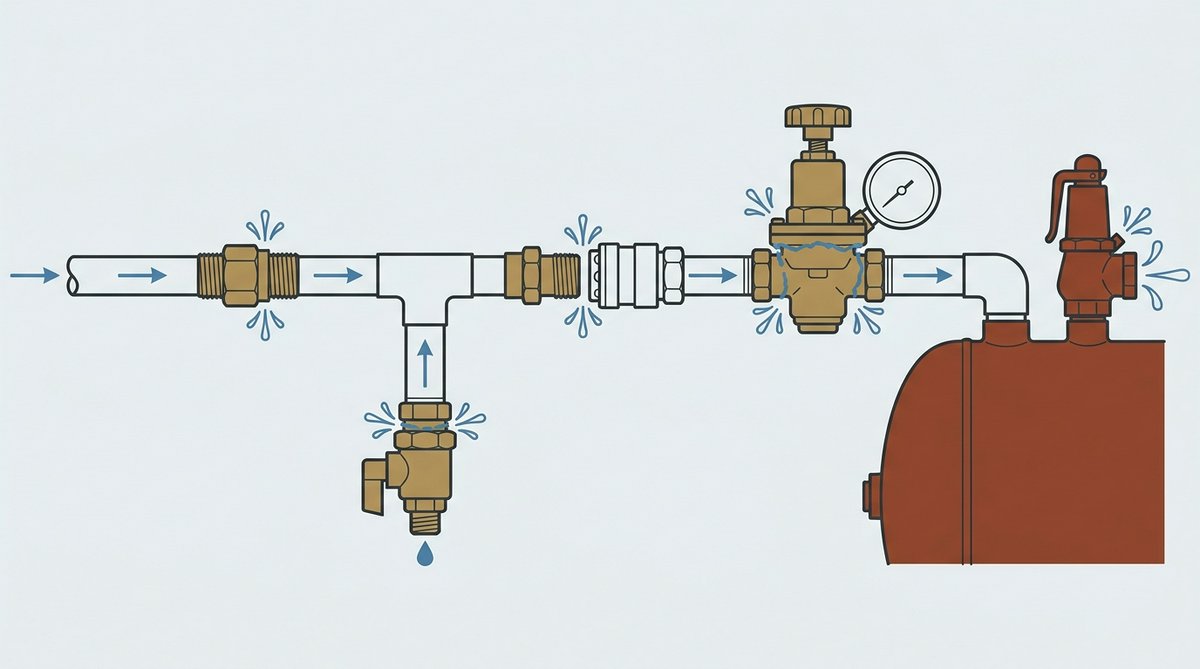
A leak rarely announces itself. Air escapes from a threaded fitting or a cracked hose at a hiss too quiet to hear over a compressor or a grinder, and the only sign is a bill that runs higher than the work seems to justify.
Fittings and quick couplers
Every joint in a compressed air line is a place where a seal can fail. Push-fit fittings, threaded connections and quick-release couplers all rely on an O-ring or a taper thread holding under pressure, and vibration, repeated connection and disconnection, and age all work against that seal over time.
Hoses
A hose that has been kinked, dragged over a sharp edge or left near a heat source develops small cracks long before it splits outright. These show up first as a thin line along the outer wall, often near a crimped end fitting where the hose flexes most.
Condensate drains
A receiver or a filter housing needs its condensate drained regularly, and the drain valve doing that job is itself a common leak point. A manual drain left slightly open, or an automatic drain valve with debris caught in the seat, bleeds air continuously.
Regulators
A pressure regulator controls the air reaching a tool, and its internal diaphragm and seat wear with use like any other moving part. A worn regulator can leak past the seat even when no tool downstream is calling for air, so the system keeps making up pressure it is losing to nothing.
Receiver valves
The safety valve, drain valve and isolation valve fitted to a receiver each carry their own seal, and any one of them can weep air slowly enough to go unnoticed on a walk past the plant room. Because the receiver holds air at the system's maximum pressure, a small leak here draws on the largest reserve in the system.
Working through a system in this order, from the receiver outward to the last fitting on the last hose, is how a leak survey finds them; the questions to ask a service firm about that survey are covered separately. Once a survey or a drop test has put a flow figure on what a fitting or a drain is losing, the Leak Cost Calculator turns that flow into an annual cost, using the compressor's rated power and your own electricity price, though the figure it returns is only as good as the flow and running hours you put into it.
What a leak survey checks, and what to ask the firm doing it
A leak survey finds where compressed air is escaping before it reaches a tool, usually with an ultrasonic detector that picks up the high-frequency hiss a leak makes, a sound above the range of normal workshop noise. The person carrying it out walks the detector along pipework, fittings, hoses, drain valves and regulators while the system is running under its normal working pressure, because a leak that only shows up under load can be missed on a system that has been shut down or bled off for the test.
What should come out of it
A written record of what was found. Ask for a list of each leak, its location on the system, an estimate of the size of the leak or the air it is losing, and some sense of priority, because a leak on a main line feeding a spray booth or a bank of tools costs more over a year than a slow one on a branch that is rarely used.
Questions worth asking before you book one
- What equipment is used to find the leaks, and will you see a reading?
- Is the system tested under its normal working pressure with tools running, or checked cold and static?
- Does the report give a location and an estimated flow for each leak, or a verbal summary on the day with nothing to keep?
- Are the leaks ranked so you know which to fix first, or is the list left in the order they happened to be found?
- Is a repair quote part of the survey, or costed separately once the leaks are listed?
Using the results
Once a leak is located and its rough size known, the same numbers work in a leak cost calculation to check what a repair is actually worth doing first. The Leak Cost Calculator takes either a measured leak flow from a survey or drop test, or a no-demand reading (the compressor running with every tool off), along with the compressor's electrical input and your own electricity price, and works out the annual cost from those figures, though the result is only as good as the numbers put into it and assumes the compressor loads roughly in proportion to the air it delivers. The same figures also belong in the specification you send when you get compressor quotes for the work.
Convert the figures, then see what a leak is costing you
A leak measured in litres per minute needs converting against a compressor rated in cubic feet per minute, or a pressure quoted in bar against one quoted in psi, before the two numbers can be compared side by side. Once they match, the Leak Cost Calculator turns a leak rate, your running hours and your own electricity price into a yearly figure, though it works from an approximation for a load and unload or variable speed machine and can be wrong if the readings behind it are.