
What the receiver is actually doing between the compressor and the tool
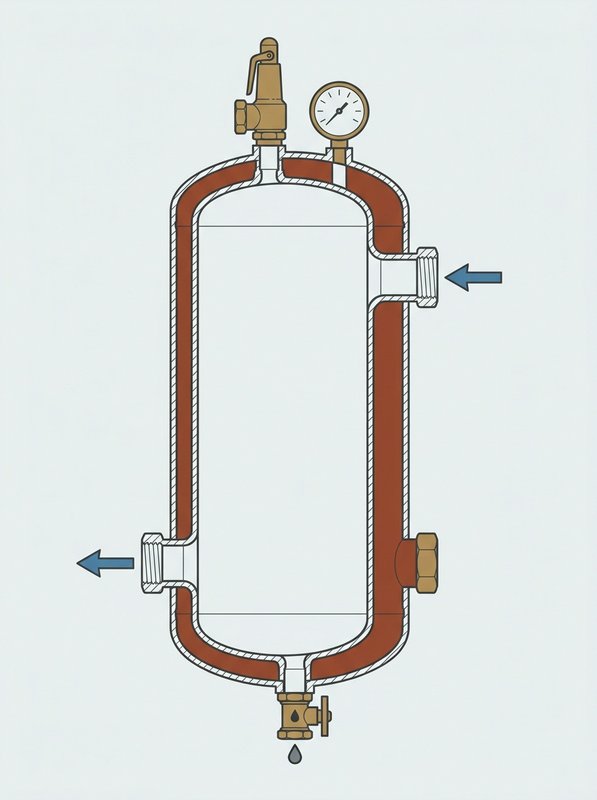
An air receiver is the storage vessel that sits between the compressor and the pipework, holding compressed air at pressure so the tools drawing from the system are not fed directly from the pump itself. Without one, every tool would have to be supplied at exactly the rate the compressor produces air, and any tool that pulls a short burst well above the compressor's output, an impact wrench or a sander cutting in for a few seconds, would starve the line the moment it opened.
The receiver's job is to smooth that difference out. While demand is low, the compressor keeps filling the receiver above what the tools need, storing the surplus. When demand spikes, the tools draw down the stored air, and the receiver's pressure falls a little until the compressor catches it back up again.
Why receiver size changes how often the compressor cycles
A compressor set to switch off at a cut-out pressure and back on at a lower cut-in pressure works through that gap in receiver volume each time. A small receiver holds a small buffer, so it drains through the cut-in to cut-out band quickly under load and the compressor cycles on and off often. A larger receiver holds more air in the same pressure band, so the same demand takes longer to drain it, and the compressor runs for longer periods with fewer starts.
That matters beyond simple wear. A compressor that starts and stops frequently spends more of its running life in the inefficient moments either side of a stop, and short-cycling is harder on the motor and the contactor than steady running. Sizing the receiver correctly is as much about how the compressor is treated over its working life as it is about keeping the line pressure steady at the tool.
Receiver size also sets a second figure worth knowing early: the bar-litre product, the receiver's internal volume in litres multiplied by its maximum allowable pressure in bar. That figure is what decides whether a written scheme of examination applies under the Pressure Systems Safety Regulations 2000, covered in its own part of this guide. The Receiver Size and Bar-Litre Checker works out both figures from numbers taken off the data plate and from the compressor's own delivery and switching pressures, and carries the same result forward from one calculation into the other. It can only work from the figures typed in, so a wrong reading off the data plate gives a wrong result, and what applies to a particular system is still a matter for a competent person's own assessment.
Sizing the receiver for a shortfall in delivery
A receiver doesn't only smooth the compressor's on/off cycling. When several tools draw air together and the combined demand runs ahead of what the compressor can deliver, the receiver has to make up the difference from what's already stored, and its size decides how many minutes it can keep doing that before pressure drops out of the working band.
The formula
The volume needed to cover that difference works out as: volume = (demand minus free air delivery) x minutes x atmospheric pressure, divided by (cut-out pressure minus cut-in pressure). Free air delivery (FAD) is what the compressor actually delivers per minute at the working pressure, measured at atmospheric conditions. Demand is the combined draw of the tools running at once, in the same units. Cut-in and cut-out are the pressures, in bar gauge, at which the compressor switches on and off, and atmospheric pressure is taken as 1.013 bar.
What each input is doing
- Demand: the litres per minute the tools pull when running together, worked out the way it's set out in How Much Air Your Tools Need.
- Free air delivery: the compressor's own output at the working pressure; see Displacement and Free Air Delivery for why the two are quoted separately.
- Cut-in and cut-out pressure: the band the compressor switches within. A wider band gives the same receiver more air to give up before pressure drops, so it changes the answer as much as the receiver's own volume does.
- Minutes of storage wanted: how long the shortfall needs covering for, which depends on how long the tools actually overlap.
Where the compressor's delivery already meets or beats the demand, there is no shortfall to store against, and this part of the sizing comes out at zero. The receiver may still need a size set by cycling or moisture separation, just not by this calculation.
Working it through with your own figures
The Receiver Size and Bar-Litre Checker takes free air delivery, demand, cut-in and cut-out pressure and the minutes wanted, and substitutes them into this formula with every step shown. It then carries the resulting volume and the cut-out pressure forward into the bar-litre check, though the pressure that check uses is the vessel's maximum allowable pressure from its data plate, which can sit above cut-out. Like any calculator, it can return the wrong answer if a figure is mistyped or read off the wrong plate, so check the inputs before treating the result as the size to buy.
The bar-litre product, and why pressure and volume are multiplied together
The bar-litre product is a receiver's maximum allowable pressure in bar multiplied by its internal volume in litres, both taken from the vessel's data plate. A 50 litre receiver rated to 11 bar has a bar-litre product of 550. A 24 litre receiver rated to 10 bar comes to 240. The number itself has no unit of its own beyond bar-litres, but it is the figure the Pressure Systems Safety Regulations 2000 use to decide what a receiver's owner has to do about it.
Why pressure and volume are multiplied together
A small receiver at high pressure and a large receiver at low pressure can hold a comparable amount of stored energy, and it is that stored energy, released suddenly if the vessel fails, that the regulations are aimed at. Multiplying the two figures together gives a single number that tracks the hazard reasonably well without needing a separate calculation for every combination of size and pressure. It is a proxy, not a measurement of risk on its own, which is why the regulations attach specific duties to the result rather than leaving it as background information.
Where the 250 line sits
- At or above 250 bar-litres, a written scheme of examination is required for the vessel.
- Below 250 bar-litres, that particular duty does not apply to the vessel, though other duties under the regulations still apply to the system it's part of.
- The figure used is the maximum allowable pressure on the data plate.
That last point catches people out. A receiver rated to 11 bar but run at 8 bar on a cut-out setting still gets tested against 11 bar for this purpose, because the data plate states what the vessel is built to withstand.
The Receiver Size and Bar-Litre Checker takes the volume and maximum allowable pressure from a data plate and returns the bar-litre product along with a statement of where it sits against 250, so you can see the sum. It runs in the browser and can only work from the figures typed into it, so a data plate misread or a volume estimated rather than measured will carry through into a wrong answer. What the result means for a particular vessel, and what else the written scheme has to cover once the threshold is crossed, is for a competent person to confirm against the system as installed.
What happens once you cross the line
Below 250 bar-litres, a receiver sits outside the written-scheme duty and the compressor supplier decides the servicing schedule. Above it, three separate things start happening at once, and each is worth taking in turn.
-
The written scheme duty switches on
Once the bar-litre product reaches 250, the receiver falls under the written scheme of examination duty set out in the Pressure Systems Safety Regulations 2000 (PSSR, Great Britain), with HSE guidance note L122 explaining what a scheme has to cover. There's no grace period built into the number itself: the duty attaches the moment the vessel's capacity and maximum pressure multiply past the line.
The Receiver Size and Bar-Litre Checker takes the volume and maximum pressure off your own receiver's data plate and works out which side of the line it falls, along with the bar-litre sum itself.
Below 250 bar-litresNo written scheme is required for the receiver on its own, though pipework or other vessels in the same system can still carry their own duties.
At or above 250 bar-litresA written scheme has to exist before the receiver is used, or as soon as reasonably practicable where it's already in service.
-
A competent person has to draw it up or certify it
The scheme isn't something the installer fills in as paperwork. It has to be drawn up, or checked and certified, by a competent person, meaning someone with the training and practical knowledge of pressure vessels to judge what kind of examination this particular receiver needs and what could actually go wrong with it. That judgement is what the rest of the scheme rests on.
-
The examination interval becomes fixed, and reviewable
The competent person sets how often the receiver gets examined, based on its condition, its duty and the risk it poses, and that interval is written into the scheme. It isn't a number the trade agrees on in advance; it can be tightened or relaxed at a later examination if the vessel's condition gives reason to.
-
A different bar-litre line applies to how the receiver was built
The 250 bar-litre figure decides whether an operator needs a written scheme once the receiver is in use. A separate line, under the Simple Pressure Vessels (Safety) Regulations 2016, governs how a welded air receiver is designed and categorised at the point of manufacture, covering vessels up to 30 bar and 10,000 bar-litres across categories A.1, A.2, A.3 and B. The two thresholds answer different questions, one about use and one about build, and crossing one says nothing about the other.
Whether a specific receiver needs a written scheme, and what that scheme should require, is a judgement for a competent person looking at that vessel. See how a written scheme is read and what a competent person is checking for, or work through your own figures with the Receiver Size and Bar-Litre Checker, and how the design-stage marks in the UKCA and CE categories relate to it.
How often does a receiver need examining?
Once a receiver crosses the 250 bar-litre line, the written scheme of examination has to set out how often it gets examined. That interval isn't fixed in the regulations themselves. HSE's approved code of practice, L122, records that air receivers are generally examined every 24 to 48 months, with intervals of up to 72 months where corrosion has been minimal.
Who sets the actual number
The interval for a specific receiver is set by the competent person writing or reviewing the scheme. They look at the condition of the vessel, what it holds, how it's used and what the corrosion history looks like, and set an interval within that range on that basis. A receiver standing outside in a damp yard and one bolted inside a dry workshop can reasonably end up on different intervals even if both are the same size and pressure.
Why the range matters to you
The interval sets how often the receiver has to come off duty for examination, so it affects planning as much as compliance. A vessel on a 24-month interval needs arranging for inspection twice as often as one on 48 months, and that has a cost and downtime attached to it even before anything is found wrong. It also means the figure quoted in a written scheme is worth checking against the vessel's actual condition.
Whether your own vessel sits above or below the 250 bar-litre threshold in the first place is a separate question, and one worth settling before the examination interval comes into it. The Receiver Size and Bar-Litre Checker takes the volume and maximum allowable pressure off your data plate and works out the bar-litre product against that line, though it can only go on the figures typed in, and it can get things wrong if the data plate is misread or missing.
None of this replaces the competent person's own assessment of a particular vessel: the range in L122 shows what is typical. For what the written scheme itself has to contain, see Sizing the Air Receiver, and the 250 Bar-Litre Line, and for the wider set of duties under the regulations, What HSE's Pressure Systems Cases Teach a Workshop Owner works through how those duties have played out in practice.
Working with these figures in other units
The bar-litre product and the receiver volume come out of the Receiver Size and Bar-Litre Checker in litres and bar. A quote sheet or a nameplate sometimes uses cubic feet or psi instead, and getting from one set of units to the other is the last step before you act on the figures.